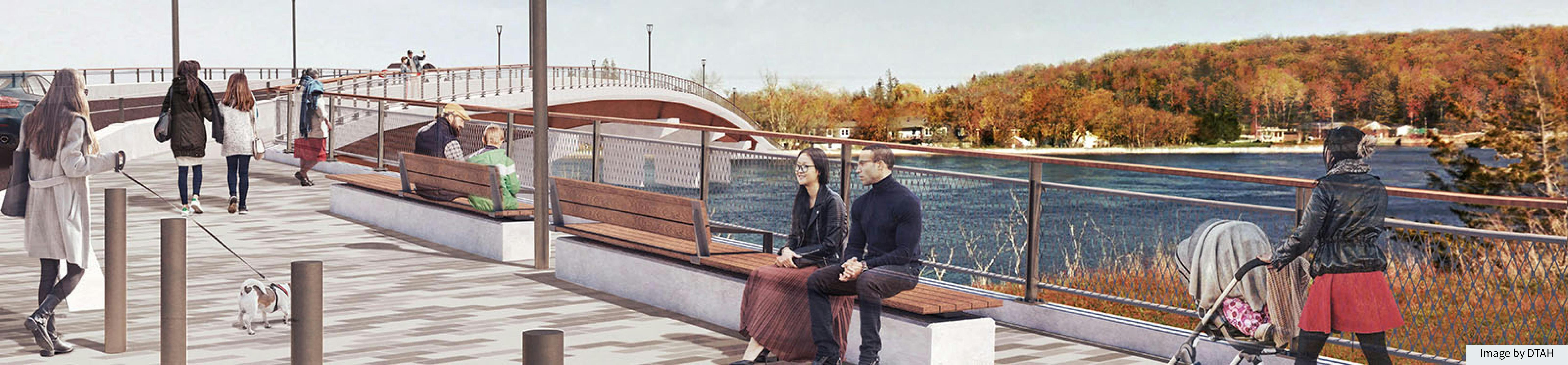
Trent River Crossing (Campbellford Bridge) and Surrounding Road Network
Project background: A new crossing for a growing community
Northumberland County is advancing plans for a second Trent River crossing in Campbellford – a generational infrastructure investment that will enhance transportation efficiency, support economic growth, and strengthen connections within the County.
Trent Hills is entering a significant growth phase, including a new regional health campus planned for Campbellford and major housing development that will anchor jobs, talent, and long-term economic activity. At the same time, the community’s business and service core is divided by the Trent–Severn Waterway and currently relies on a single bridge built more than 60 years ago. This creates a growing vulnerability for public safety, emergency response, and economic activity—particularly as the existing bridge will require major rehabilitation and periodic closures within the next five years.
A second Trent River Crossing is essential 21st-century infrastructure. It will support the safe and reliable movement of people and goods between Highways 401 and 7, reduce congestion and associated emissions, improve emergency access, and strengthen overall community resilience. Importantly, this project is not just about a bridge—it includes significant improvements to the surrounding road network to enhance traffic flow, safety, and active transportation connections throughout the community.
This project reflects a forward-thinking, community-led vision that balances heritage and environmental stewardship with growth and innovation. It is poised to deliver long-term value for taxpayers, residents, and future generations across Northumberland County and its member municipalities.
Planning and Approvals
The Trent River Crossing Project was approved by the Ontario Minister of the Environment, Conservation and Parks in 2017 following an extensive Schedule ‘C’ Municipal Class Environmental Assessment (EA) process. Studies informing the preferred solution were undertaken between 2008 and 2016.
The approved design includes a new bridge linking Second Street on the east side of the river to Alma Street on the west. The crossing will significantly reduce congestion on the existing bridge and improve safety and mobility for vehicles, pedestrians, and cyclists, while also strengthening the broader regional transportation network.
Community-Driven Design and Indigenous Engagement
This project has been shaped by extensive public, stakeholder, agency, and Indigenous engagement over more than a decade. Input received through multiple rounds of consultation—from early planning in 2014 through public information sessions in 2020 and 2023—has helped define priorities, identify opportunities, and refine the design.
Engagement with Indigenous communities, including the Williams Treaties First Nations and the Mohawks of the Bay of Quinte, has been ongoing since 2008. These discussions focused on fish habitat, species at risk, archaeological considerations, and opportunities to meaningfully reflect Indigenous history and culture within the project. The result is a design that respects the historic and cultural significance of the Trent River while supporting modern infrastructure needs.
The outcome is a transportation corridor designed not only for traffic movement, but as a community space that integrates with the surrounding neighbourhood, natural environment, and cultural landscape.
Trent River Crossing: Project Rationale
The need for a second crossing is driven by both current pressures and future growth:
- Growth and Transportation Demand
Campbellford and Trent Hills continue to grow, with approximately 5,000 vehicle crossings per day on the existing bridge. A second crossing will ensure safe, reliable access for residents, businesses, visitors, and emergency services as demand increases. - Economic Growth and Jobs
The project is expected to generate more than 330- 550 direct and indirect jobs during construction, supporting skilled trades and rural economic development. Improved transportation efficiency will strengthen local businesses and tourism, which already brings an estimated 272,000 visitors to the region each year. - Community Resilience and Safety
Relying on a single river crossing creates significant risk. A secondary route will protect the community from future disruptions, including planned bridge repairs, emergencies, or unexpected closures that could otherwise add 20 minutes or more to response times. - Active Transportation and Sustainability
New sidewalks, cycling lanes, and multi-use paths will promote safe, low-carbon travel options and improve access for all road users, aligning with climate-resilient infrastructure goals.
To review the full report Bridging Generations, Building Connections, Driving Growth please see the documents section.
Funding and Next Steps
Design for the Trent River Crossing is nearly complete, and Northumberland County has committed $10 million toward the approximate $55 million project. While development charges will contribute, they cannot fully fund a project of this scale without limiting the County’s ability to invest in other critical infrastructure.
With new provincial and federal infrastructure programs anticipated, the Trent River Crossing represents a shovel-ready opportunity aligned with government priorities for climate-resilient, housing-enabling, future-focused infrastructure. Timely senior government investment will help protect existing public investments, unlock regional economic growth, and reinforce long-term community resilience in Eastern Ontario—one of the fastest-growing regions in the province.
Project Design
- The proposed 188-metre bridge and surrounding network improvements will include:
- Two travel lanes for vehicles
- Dedicated pedestrian sidewalks and bicycle lanes
- Five bridge spans and four piers
- A roundabout at the Grand Road/Alma Street intersection
- A pedestrian/cyclist pathway along the Trent River under the bridge
- An overpass over Saskatoon Avenue on the east side
- Intersection upgrades and new active transportation infrastructure on surrounding roads
Project Status
- Design work began in Spring 2019, following approval of the EA and environmental studies dating back to 2008.
- Public information sessions were held in 2020 and 2023 to share design concepts and gather community feedback.
- Based on feedback, an Addendum to the Environmental Study Report (ESR) was issued in March 2021, confirming design updates including the roundabout on the west approach.
- Final detailed design is anticipated to be completed by the end of 2025.
- In 2025, the County began the process to acquire the necessary adjacent properties to support the construction of the bridge.
- Construction activities began in 2025 with the relocation of utilities. Demolition of three homes is planned for the fall of 2025.
- In early 2026, it is anticipated that a project tender will be issued, dependent on approval of financing and permits
You can find a full project timeline on the right-hand side of this page.
Stay Involved
Northumberland County remains committed to an open and inclusive process. Public feedback continues to shape this project, and further opportunities for engagement will be shared throughout the next phases.
- Subscribe to our email list to receive project updates and engagement opportunities. Click 'Subscribe' under the 'Stay Informed' box.
- Review project documents from the 2020 and 2023 public information sessions, available in the ‘Documents’ section on the right.
Join in the conversation
- Subscribe to our email distribution list for updates about the project and opportunities to provide your feedback. Click 'subscribe' under the 'Stay Informed' box.
- Review materials from the first round of public information sessions in 2020, as well as the second public information session in April of 2023 in teh document section to the right.
Review the detailed design
Watch a video of the proposed design plan
View an interactive map
Review the detailed design presentation
Or download an accessible PDF copy of this presentation.
Who's Listening
-

-

Email jim.peters@trenthills.ca -

Email rebecca.farrugia@ghd.com
Reports and Documents
-
 Trent River Crossing Report Bridging Generations. Building Connections. Driving Growth. (2.58 MB) (pdf)
-
 Environmental Study
-
Environmental Study Report (Feb 2016) (5.94 MB) (pdf)
-
Environmental Study Report - Appendices 1 - 2 (August 2014) (39 MB) (pdf)
-
Environmental Study Report - Appendix 3 (July 2012) (19.2 MB) (pdf)
-
Environmental Study Report - Appendices 4 to 8 (Aug 2014) (37.5 MB) (pdf)
-
Environmental Study Report - Appendices 9-10 and 12-13 (August 2014) (5.07 MB) (pdf)
-
Environmental Study Report - Appendix 11 (August 2014) (37.7 MB) (pdf)
-
Addendum - Expanded Environmental Noise Assessment Report (June 2013) (4.06 MB) (pdf)
-
Addendum to the Environmental Study Report (Mar 2021) (12.3 MB) (pdf)
-
-
Implementation Plan: Crossing & Arterial Road Network (Nov 2017) (5.26 MB) (pdf)
-
Public Information Sessions
-
Trent River Crossing Detailed Design Update (April 2023) (6.33 MB) (pdf)


I would hope the old Train Bridge piers would be removed as part of constructing the new bridge construction.
PLEASE SAVE THE OLD OAK TREE 🌳
1. the bridge design does not meet any of the Heritage Study's 10 recommendations, especially that it be suited to a heritage neighbourhood.
2. entrances to Tim's, Can. Tire, the bridge and Alma St. will make traffic on a roundabout very stressful for everyone. It will be slower than our current bridge (which is no longer slow now that the long-requested-improvement-of-light-sequences has been implemented!!).
3. this bridge does NOT "RESPECT the importance of history and heritage of the Trent River" as you say, or it would not cut through and require removal of heritage homes. It is over the widest part of the river.
4. this was NOT A "COMMUNITY-DRIVEN process as the community's concerns" were never incorporated. The committee made decisions, listened to the community at Open Houses, but made no changes as a result.
5. a bridge of this size will bring commuter traffic through town but not into our core area for merchants, but will bring noise and air pollution as vehicles will pass closely by established homes. Heart, lung and respiratory diseases will become more prevalent in the community, a well-known fact .
6. this bridge does NOT provide "vibrant gathering places". Who wants to sit beside a busy bridge? People don't sit there now on the benches provided. It is too noisy and busy to be restful or beautiful.
7. this bridge is NOT NEEDED. It was based on population growth of 2%/year which will never happened here because we are too far from highways 7 and 401. The bridge should be further south to meet 407. Traffic studies were taken during our busiest season and over the long weekend.
8. for years, the light sequences 'could not' be changed as the elders in town would have accidents. However, now they will have to adjust to a very busy roundabout at an already very busy connector road.
9. the exit on the west side up Simpson Street will lead to a lot of traffic congestion, on a hill for large trucks and turning left onto Bridge St. going north.
10. traffic from the south on the east side will create chaos where Saskatoon joins Front St just south of the bridge.
11. bridges do NOT CREATE COMMUNITY. This one will destroy ours.
We are moving toward active and greener transportation. More people will be biking (look at increase in e-bikes). This bridge needs a separated bike lane to connect to the trail system as well. Is there currently a plan to include separated bike lanes on the new bridge? Thank you.
I have great concern regarding the pedestrian crossing at Second St. and Front St. With the large amount of seniors crossing at this intersection, due to the seniors apartments on the south side of Second Street. Potentially this will be a very busy intersection. Seniors with walker and wheel chairs take extra time to cross the road and I'm not sure a cross walk will insure their safety.
Your public information sessions were very well planned and executed.
My primary concern is the Simpson/Bridge St intersection. I can anticipate a great deal of congestion and difficulty with large transports, negotiating that turn.
Thank you for your comment around the design of the bridge.
As we progress the detailed design in the coming months, we will take into consideration the public input we have heard on the aesthetics of the bridge to further shape design elements that respect both the history and heritage of the community and the importance of the Trent River. As well, we are in discussions with Indigenous communities to assist the project team around opportunities to include an Indigenous people’s culture perspective.
Regards, Trent River Crossing Project Team
This bridge design is truly a disappointment given its prominent and beautiful location over the Trent River. I had hoped to see some creativity – a single tall pylon coupled with cable stays; perhaps two sweeping arches crisscrossing and suspending the bridge deck over the river; something a little less boring than just another purely utilitarian bridge. Residents of, and visitors to, Campbellford will be looking at this bridge for decades to come. Surely we could use something less reminiscent of Soviet industrial architecture. The design doesn’t even include a symbol that acknowledges, and pays respect to the first peoples of the area – an eagle, a bear, a medicine wheel, a dream catcher, nothing! How incredibly disappointing and boring. We can do so much better so, please, let’s give it another go.
Nice bridge … except the railing. Very functional and industrial, which is ok. But consider this is a tourist destination with all those on the trent severn waterway passing under this bridge. Consider having a more artistic metal fabrication that makes the bridge a showcase. Perhaps a design contest is in order to get the community involved?
Thank you for your question "two lane Bridge".
Bridges in Canada are designed to last 75 years with regular maintenance and capital investment. The Campbellford Bridge was built in 1968 and therefore is expected to last another 20+ years. The new proposed Trent River Crossing was designed based on traffic studies and growth projections that looked well into the future life of the bridge and included considerations such as, respecting the history and heritage of the Trent River as well as keeping with the community.
Hope this answers your question . Regards, Northumberland County.
I noticed that the plan is for a “Two Lane” bridge.
What is the anticipated lifespan of the current bridge? When will the old bridge come to its bridge lifespan end ?
It appears with added housing, increased population, potential new hospital along with the old bridge soon to be end of life. It might be wise to build a 4-lane bridge or alternate plans should be considered!
Thanks,